|
| Product placement ahoy! |
Movie: Zootopia
Director: Byron Howard, Rich Moore,Jared Bush,
Cast: Ginnifer Goodwin, Jason Bateman, Shakira
Verdict:
Part buddy-cop dramedy, part racial allegory, Walt Disney’s latest offering is a touching and timely movie, blessed with well-rounded characters, smart dialogue, and top-notch storytelling that’s sure to leave you howling with joy on your way out the theater.
In depth:
What does it mean to live in a diverse environment? Is it possible to be prejudiced without being malevolent? These are some pretty heavy questions - too heavy, it seems, for Hollywood to tackle in any sophisticated way. Every now and then a feature crops up, condemning all the usual suspects, parading a cast of dubious and unsympathetic antagonists, just to drive home the point that racism is bad. But simple, everyday prejudice? That’s been left mostly out in the cold, untouched for reasons I'm sure any psychologist would happily examine. So it’s amazing to find the first mature treatment of so sensitive a topic in a 3d movie supposedly aimed at children. But the facts don’t lie: Zootopia delivers a powerful message on tolerance and racism that doesn’t sacrifice its characters, plot, or humor, making it one of the most enjoyable and well-rounded family films ever released by Disney.
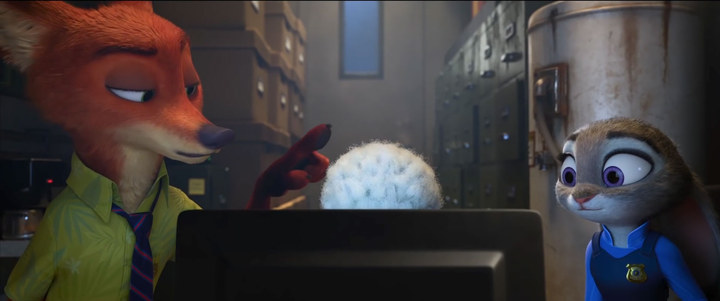
It all takes place in a world where humans don’t exist, and both predator and prey have presumably moved past their primitive instincts toward something…sorta like peace and harmony. Country bunny Judy Hopps (Goodwin) aspires to be a police officer in Zootopia, the sprawling metropolis serving as the nerve center for this interspecies cosmos. Though from the beginning we start to suspect that not all is hunky-dory - particularly as young Judy contends with both a bullying fox and her own fretful parents - she remains unperturbed, and after a grueling run in the police academy sets off to fulfill her dreams in the big city. It’s too bad that everything in Zootopia is hell-bent on crushing her fragile, hard-won optimism. After all the fanfare thrown at her for being the city’s first rabbit cop, Judy finds her fellow officers, including police chief Bogo (Idris Elba) less than thrilled to have her on the force. She’s immediately bumped down to parking duty, her hope of making the world a better place frustrated at every turn, before a flash of impulsiveness and a stroke of bad luck lands her before a sticky ultimatum: solve a missing predators case in 48 hours (sound familiar?) or turn in her badge in disgrace. Her only lead is entrepreneurial con artist Nick Wilde (Jason Bateman), a sly fox with his own complicated relationship with Zootopia to work through. As Judy and her unwilling partner race against the clock, she finds out there's a lot more to everything and everyone around her than appearances suggest - including herself.
 |
| "Yeah, seriously - don't." |
From a set up that promises nostalgic flashes of Nick Nolte and Eddie Murphy in PG form, Zootopia quickly swerves into some pretty serious racial territory. The amazing thing is how it does so without losing any of its charm or comedic flare. Like an agile predator, it nimbly straddles the line between buddy cop comedy and social commentary - often blending the two, like when Judy lays out “C-word privileges” to a fellow officer (“...a bunny can call another bunny cute, but when other animals do it…” ) or when Nick has an awkward “can I touch your hair?” moment with a sheep. It’s a brand of hilariously uncomfortable humor aimed squarely at the parents in the theater - reminding us, perhaps, of similar indiscretions in our own lives - and doesn't come across as preachy in the least. But when the movie gets serious, it doesn’t pull any punches; few, if any, animated features from mainstream productions tackle the often insidious and overlooked existence of institutional racism and personal biases. By sheer brilliance, the filmmakers avoid both moralizing and direct analogues to real life, eschewing simple fables of acceptable targets to examine the roots and wreckage of prejudice lying within everyone.
And this wouldn’t have worked had it not been for the strength of the characters inhabiting this world.
Judy is a pure joy to watch, an energetic and enthusiastic persona obviously constructed with great care and foresight. She’s the perfect blend of naivety and strength, believing in her ability to make her dreams come true, but not immune to doubt and insecurity, especially when her rose-tinted view of Zootopia cracks right before her eyes. Goodwin injects our young heroine with enough sweetness to almost convince you that she’d fall for just about anything...before she slyly manipulates the tar out of many characters perceived as more cunning and ruthless. But she isn’t just the innocent victim in all of this, fighting against an establishment with narrow expectations of her. Judy’s flaws, like her impulsiveness and need to prove herself, are often her own worst enemies, and she comes with her own racial baggage, profiling foxes specifically and predators in general, which culminates with her delivering the film’s most troubling instance of institutional prejudice - all without malice or any ill intent.
 |
| Pretty much exactly like the DMV in real life. |
Nick had to grow on me for a bit, since he came off at first as just another “savvy” male foil to energetic female protagonist that’s become such a tired mainstay of anime and modern Disney features alike, with hardly an independent trait to call his own. But once his backstory kicks in and Judy’s own shortcomings become more obvious, you appreciate his witty interjections and calm, thoughtful counterpoint to the often hot-headed bunny cop. He reveals how much he’s personally suffered under Zootopia’s strained interspecies tolerance, and it’s obvious that however much he plays up the “scam-artist fox” stereotype, he’s too earnest and too disgusted by inequity to completely pull it off. Bateman’s timing and humor really carry the day, and the chemistry between Nick and Judy isn’t just palatable - it’s damn-near explosive. These characters, individually complex and fleshed-out, never overshadow one another, and while there’s enough fodder to keep the shipping segment of the fandom occupied, their layered and touching interactions - as close friends, partners, and confidants - have enough power to back a sequel or two, or even a television series.
 |
| Scenery porn? Damn straight. |
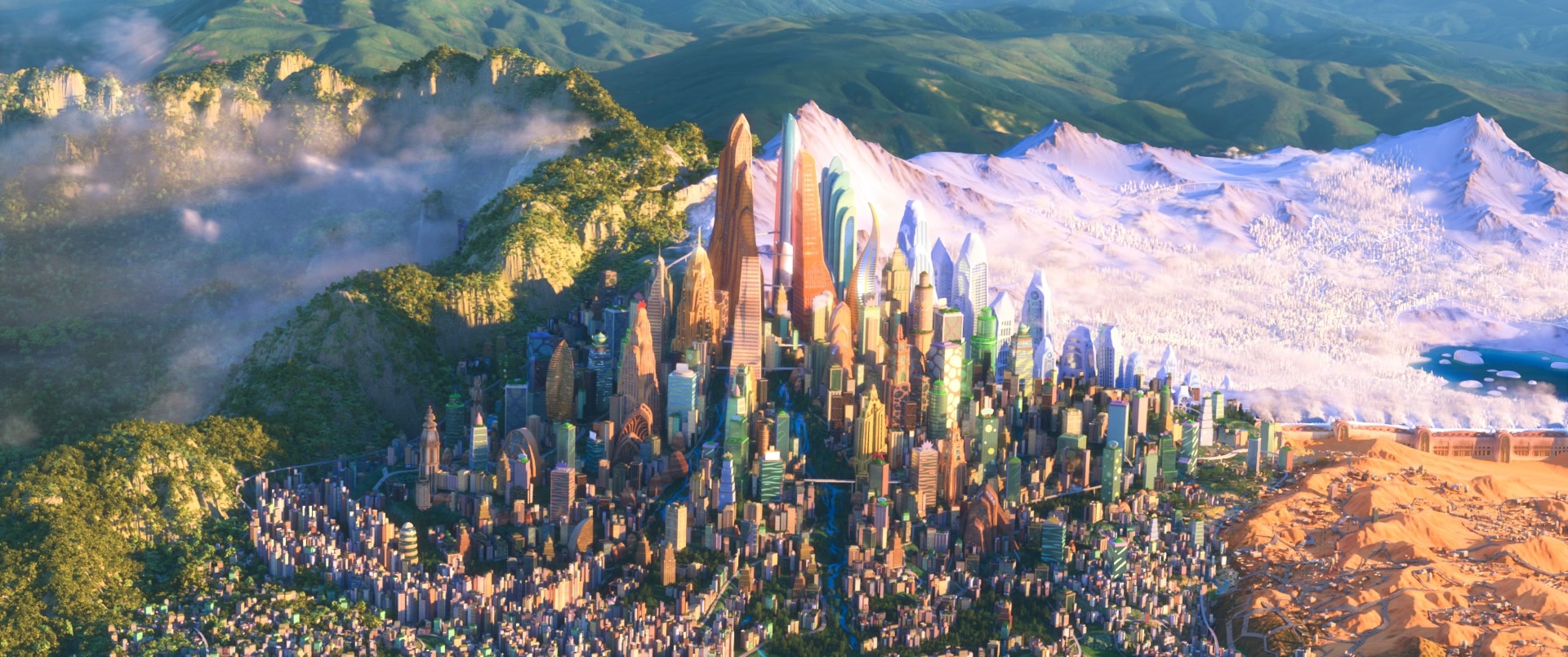
Besides the phenomenal story and characters, the 3d is gorgeous, as expected. Judy arrives in Zootopia in a realistically rendered high-speed railway meant solely to showcase how much detail went into designing the animal metropolis - from the smokey clouds in the Rainforest District, to the frigid beauty of Tundratown. But the scenery isn’t just there to be gawked at; it’s almost a character in itself, at times living up to the ideal of a beautiful, bustling city with unlimited opportunities, but only a trick of lighting and the right color palette away from exposing a seedier, darker underbelly, complete with mob bosses, hidden agendas, and unresolved tensions forged in millennia of predator/prey conflict. The animators spared nothing in bringing this cityscape to life, and it should be a lesson to anyone interested in creative world-building.
With so much praise, there has to be some drastic misstep to balance it out, right? Well, yes and no; it has its flaws, of course, but they're minimal at the very worst. Disney’s recent obsession for the “surprise villain” shtick is getting old, and anyone tired of it will surely roll their eyes at the big "reveal." However, the blow is softened by the weightiness of Zootopia’s plot. The problem with these kinds of antagonists is that they’re too often given insufficient motive or development in order to keep the “shock” factor in play. But Zootopia comes complete with its own “build your villain” package, thanks to the racial and political ramifications of only half-heartedly embracing diversity. Was Hitler’s rise a product of 20th century Germany’s ethnic milieu? Would the Rwandan genocide have occurred had there not been such a sharp line drawn between Hutu and Tutsi? Who knows, but a little understanding of history puts Zootopia's bad guy in a pretty believable light.
Beyond that, and a little exaggeration when Judy finally confronts her own inner demons, I have nothing bad to say about it. I admit I hissed through my teeth at everyone claiming this was the best thing since The Lion King, but that might not be far off the mark. I don’t know if the crew at Disney has anything else in mind for Judy, Nick, and the rest of the cast, but this is one franchise I'd be thrilled to see take off.
Grade: A+