Showing posts with label sci-fi. Show all posts

Friday, July 29, 2016

'Beyond' is a smart and funny sci-fi joyride


To boldly go where...ah hell, you know the rest


Movie: Star Trek Beyond
Directed by: Justin Lin
Starring: Chris Pine, Zachary Quinto, Anton Yelchin

Verdict:
The boys and girls of the new Enterprise have done it again, this time cranking out a fun and fast-paced film that, while undeniably cheesy, overflows with old-school charm and enough action to keep you bolted in for the whole wild ride to the Final Frontier.

In depth:
I have a confession: I have yet to see either of the previous Star Trek revamps.  I'm not much of a fan of the franchise itself - barring The Wrath of Khan and Patrick Stewart’s delightful bald of awesome - and so avoided the fanwagon and the hatemobile when the first Star Trek AU hit the big screen a few years back.  Which means that I came in with no expectations or prejudices, armed only with an open-mind and some fond (if limited) memories of the older movies.  Fortunately, unlike so many times this year, my good faith wasn't bludgeoned like a baby seal.  Not only was Beyond intelligible to a novice like me, being a solid standalone film; but it was a damn good movie all around, keeping steady pace on the action while indulging in a good bit of the wit, fun, and daring that made the original series the cult icon that it is today.

The film drops us in the dark of space, where the USS Enterprise, at day 966 of its five-year tour, is starting to lull in the tedium of its peacekeeping routine.  The dashing Captain James T. Kirk (Chris Pine) in particular is catching the grind, feeling world weary (or “space weary”) while getting all existential about his approaching birthday.  The crew eventually arrives at Yorktown - a spectacularly realized if gaudy space city wrapped in a bubble dome - and set about restocking and sorting out their individual issues, including Kirk’s malaise and the promise of a promotion, Spock’s (Quinto) amicable break-up with the stunning Lt. Uhura, as well as news of Ambassador Spock’s unfortunate passing.  These little nuggets of self-reflection are interrupted when a damaged escape pod literally drops out from a nearby nebula.  Its passenger claims that her ship was taken down by an unknown force, marooning on a similarly unknown planet in the heart of the dust cloud.   So the Enterprise sets out on what's supposed to be a routine recon mission; but of course, this being Star Trek, nothing ever goes as planned, and when the crew flops down on the alien world after an attack by the mysterious pirate-warlord Krall (played by Idris Alba) Kirk, Spock, and the rest race against time to stop the madman’s scheme, all while trying to find a way back home.

"Did anyone bring a compass?"

Right from the start, Beyond doesn’t waste any time setting up the plot and the major conflicts churning it.  Kirk’s concerns over his birthday and his father’s early death, Spock’s relationship troubles, and the myriad of interpersonal problems dotting the crew here and there, are all covered quickly but efficiently - doing justice to the underlying feelings, but not drawing them out for unnecessary melodrama.  Okay, sure - there ain’t exactly a whole lot going on here to begin with, so it shouldn’t be that hard.  But you’d be amazed how many action movies aspire to heights of “pathos,” only to land flat on their faces in the Zone of Pretension.  Beyond dodges that minefield by not pretending to be anything other than what it is: a smart, fun sci-fi adventure flick that pushes a few intriguing suggestions, but nonetheless recognizes that its main purpose is to entertain.

And entertain it most certainly does, in no small way thanks to the tight pacing of director Justin Lin.  Rarely does a movie fit its scenes together so well that you don’t even notice where one begins and the other ends.  Not much felt hurried or incomplete; nor was I constantly eyeing the theater door, languishing in movie drag and waiting to be put out of my misery.  Everything flowed effortlessly.  From the scenes in Yorktown, to the thrilling dogfight against Krall’s crew, and all throughout the film, Lin painted the action with care and an attentive eye, always aware of his movie’s tempo, and knowing when to push the pedal to the floor or ease up on the gas - a talent I wish more directors had.  The frenetic pace is never overwhelming, and as a result, the plot is as sleek as a newly-christened starship.
"First one to say 'Mary Sue' is gonna talk to the stick

But the actors are the real stars here, and the cast, charging down the silver screen in their third run together, were definitely up to the task.  Though Pine, Quinto and the rest are more or less strangers to me regarding their roles, in the end it didn’t matter; each actor embodied his or her character to the absolute tee.  Pine managed to blend Kirk’s strengths - his charming bravado, as well as his tricky balancing act of vulnerable masculinity - without the irritants of his at times macho and womanizing behavior.  Quinto and Karl Urban, the later portraying “Bones” McCoy as the third leg in the iconic Freudian Trio, really got to play off of each other in this film, spending a great deal of time in close company, perfectly melding the rivalry, subtle respect, and ribbing comradery that colors their relationship so well.  Ironically, the real stand out in the cast was the one I expected the least from - newcomer Sofia Boutella, playing Jaylah, an alien scavenger and survivor on the world they crashed on.  This nubile, white-skinned maiden is a queer mix of funny foreigner and walking deus ex machina - providing amusing off-kilter commentary (referring to the grounded ship she’s commandeered as “her house”) as well as a convenient way of resolving most of the crew’s problems.  By all accounts this should've made her an unpleasant addition to the tight-knit crew, but her combination of vulnerable innocence and hard-boiled tenacity really works out in the end - so much so that she left me hoping for another appearance in the future.


But really, behind all the pieces that fit together like a windup clock is the simple fact that Beyond is just a straight-up fun movie.  I know - “fun” is hardly an exact descriptive, but it’s a fairly accurate one.  Beyond flows like an old-school sci-fi pulp flick, but without the annoying trappings of that bygone era.  There are no rubber forehead aliens or green-skinned babes in metal bikinis, but there’s plenty of humor, daring and machismo to go around - with even several members of the fairer sex getting a hand on the action.  When Kirk leads a siege on Krall’s base mounted on a motorcycle, or attacks his swarm ships with the blaring “classical” rifts of the Beastie Boys’ “Sabotage,” you don’t have time to whine over the scenes' lack of realism or anachronistic qualities.  They’re so well-made and crank up the adrenaline rush to such a degree that if you have any kind of a pulse, you’ll likely be giving a round of applause at the stellar execution.
Yeah, don't think insurance is going to cover this

So is there some fatal flaw to Beyond - something to temper all the laudation and knock the Enterprise back a few parsecs?  Well, a couple of things were amiss, but nothing that breaks the overall thrilling experience.  The scenes described above are unashamedly cheesy, of course, but it’s a good kind of cheese, falling well in line with this revamp’s apparent forte of balancing the novelty of the past with the realities of the present.  There were a few plot holes sinking in beneath Krall’s true identity, though; the revelation came completely out of the blue, and the “deductive” means by which they arrived there stretches the bonds of credulity more than anything else in the movie.  I also wasn’t impressed by the film’s pyrotechnics and often bald CGI.   Although the initial panoramic of Yorktown was a sight to behold, even then it felt more like a prop to be marveled at than a natural part of the world.  The filmmakers were probably aware of this, giving Bones a voice to humorously point out how the space city looks like a “giant snow globe,” and should have been placed on solid ground instead.

But that little dip into self-effacement only highlights the wit and whimsy pervading every aspect of the production.  At no point does the movie ever take itself too seriously, dispensing even the most navel-gazing questions with a muted one-liner and keeping the focus where it belongs.  There’s nothing groundbreaking or even exceptionally memorable here, but if you’re looking for a solid action movie with more brains than the norm and a nice helping of phaser beams, I can’t think of a better way to spend an afternoon than booking a voyage with this veteran crew for one hell of a trip.

Grade: B+  

Tuesday, July 28, 2015

Movie Review: Terminator Genisys

 http://www.mangaforever.net/wp-content/uploads/2015/04/Terminator-Genisys.jpg


Movie: Terminator Genisys
Directed by: Alan Taylor
Starring: Arnold Schwarzenegger, Jason Clarke, Emilia Clarke

Verdict:
Terminator Genisys tries to undo the damage wrought to the renowned sci-fi series by Salvation, but while the Governator adds a surprising charm to his tired role of mechanized guardian, the unwieldy time travel plot, mechanical acting, and a serious case of continuity lockout almost had me longing to hop in a time machine and reclaim my lost 126 minutes.

In depth:
I’ve long admired The Terminator for practically codifying the type of dark Cyberpunk that would eventually become such a cliche a decade or two later, so it’s no surprise that I had a strong, visceral reaction to the news that they were coming out with yet another sequel.  Like Jurassic World, Genisys has been smothering box office premieres for the past few months with a cascade of teasers that offered plenty of visuals, but very little story.  I learned well from the god-awful train wreck that was The Last Airbender to be skeptical of any preview that follows this formula, and I certainly wasn’t fond of any attempt to resurrect a franchise that may have served its purpose admirably in the past, but was now better off resting in peace.  But, then again, I had said the same thing about Jurassic World, and while I’d hardly call it a masterpiece, I was, nonetheless, pleasantly surprised.  Unfortunately, I can’t quite say the same for Genisys, for although it works reasonably well as a mindless action flick, even this meager fun is dampened by the stale acting and mind-bendingly convoluted plot.

Like its predecessor, Terminator: Salvation, our story begins in the future, where John Connor (Clarke), the ever crucial leader of the Human Resistance Movement, was set to launch the final offensive against the drone army of the homicidal A.I. system Skynet.  With him as always was a contingent of Red Shirts and the his ever-faithful right hand, Kyle Reese, played this time by actor and living crash test dummy Jai Courtney.   Admittedly, these early battles and the obligatory exposition they embodied were quite enjoyable; as a Terminator fan, I’ve always wanted to get a glimpse at the final few days leading to the future destruction of Skynet, and the time travel plot that set the mythos in motion.  Plus, all of its other soon-to-be discussed failings aside, Genisys doesn't skimp on the action one bit, and proved remarkably proficient at building tension - a key action ingredient many modern movies tend to neglect.  Jason Clarke was perfunctory as the legendary figure, his typically lazy and understated method of acting for once actually adding character by nailing down Connor as a weary, prophetic old soldier.   

On the other hand, I had an...unpleasant reaction to seeing Courtney step up as Kyle Reese. The time-traveling soldier is arguably the great cipher in the Terminator franchise, as he is pretty much the Adam to Sarah Connor’s Eve in terms of root importance to the fate of the future, and yet receives little recognition in comparison - not counting the laughable travesty that was Salvation.  However, I didn’t believe for one second that Courtney could do Reese any justice.  His acting is notoriously wooden, and I predicted that he would likely fade into the background as soon as the plot really kicked off - and sure enough, Courtney didn’t disappoint.  Throughout the first fifteen minutes or so he was barely a presence on screen, being overshadowed by Jason Clarke (yes, really) and filling more the role of a spectator than a participant.  While you may make excuses in the beginning as this being Connor's way of keeping Reese out of the action in order to preserve his own existence, this becomes impossible as the movie drags on and Courtney's stiffness and general lack of charisma grates like nails on a chalkboard.  Michael Biehn may not have been the world’s best actor, but Kyle Reese felt alive in his hands - tense, militarized and unsociable, but still very much alive.  Courtney offers nothing but a pretty face and a well-built physique, and I was both astounded and disappointed by how very little I had to think of him over the course of the film.  

Fortunately, Jai-doll’s co stars were there to help pick up the slack, though just barely.  Emma Clarke was an odd choice as Sarah Connor, but eventually an acceptable one nonetheless, storming in like a bat out of hell soon after Reese and the T-800 are deposited unceremoniously on the streets to inform the good soldier that everything he (i.e., we, the audience) was expecting is wrong.  I was displeased at what I initially thought was a shallow bid for “grrl powa,” the kind of janky, “I don’t need you to protect me!” mindset that seems tacky in a cinema climate that’s far more accepting of strong female characters, even if there’s a long way to go still.  Thankfully, the filmmakers steered her in another direction, giving a sensible reason behind her attitude and even linking it to the series-wide theme of fate and predestination - something the rest of the movie apparently forgot.  Still, Clarke plays a recovering child soldier with little depth or conviction, stifling the desperately needed level of gravitas that had always been a staple in the series, but yet seems mostly absent here.  

There was one star that didn’t fail to slap a smile on my face - and ironically, he was the one I least expected.  There was a lot of buzz both before and after Genisys’ release centered on Mr. Schwarzenegger and his status as a box office draw; his performances since his retirement from politics has been a thoroughly mixed bag in the strictest sense, with a few enjoyable surprises and a lot of trash.  To be honest, I err on the side of the neighsayers, especially since Schwarzenegger hasn’t been the engine of any big movie publicity since, and I’m being very generous here, End of Days. That said, Genisys, much like The Last Stand, shows that the aging action hero still has a certain charm and appeal that will never truly fade.  Although the Terminator character, affectionately named “Pops” in this incarnation, doesn’t allow much in range, the veteran actor knew how to exploit every cranny to either get a good laugh, like his hilariously creepy attempt to fit in by smiling, or to convey the film’s few moments of well-executed pathos. It’s sad to say that he’s the only character who evoked genuine concern over his survival from me.

So far, what I’ve described seems like the makings of a kinda fun if thoroughly "meh" movie.  So what went wrong?  It wasn’t Courtney woodenness, or Clarke’s uneasy grasp of a legacy role she can’t quite fill; it wasn’t Schwarzenegger’s faded Hollywood star, or audience apathy in the wake of yet another Terminator sequel.  In fact, it was all of these things, but wrapped in a convoluted plot that ties itself into an incomprehensibly tight knot, leaving little room for anyone who has not been following this series from the beginning.  I got my first warning sign right at the start; everything immediately after Reese followed the original Terminator through time - where both he and the killer cyborg landed, the reactions of the bystanders, and even the encounter with the hobo in the alley - mirrored the original Terminator sequence of events to the tee.  The problem is that we aren’t quite sure of the purpose for all this: is it a homage to the original film, a little inside treat for the series’ long-time fans?  Or was it a stamp of recognition, letting the viewers know that this wasn’t their parents’ Terminator?  I suspect that it was all of the above, but the execution was so clumsy that the likely result for most newcomers to the franchise was a great deal of confusion.  This, of course, is a serious problem, as a sequel - and most definitely an alternate remake - should stand on its ability to draw in new viewers who need not be versed in the series’ past lore.  Unfortunately, Genisys ignores this basic cinema principle, and I can only imagine how the rare Terminator newcomer must have felt watching it, as I know I would have been completely baffled by the inside references and their annoying prominence on the screen had I no familiarity with the franchise.

If the continuity lockout wasn’t enough, the movie's extraordinarily confusing take on the time travel plot renders any attempt at reaching clarity totally futile.  This is rather sad, as one of many boons of the Terminator series as a whole is the relative simplicity with which it approached time travel; not particularly realistic, but at least it didn’t require a Masters in Physics just to keep up.  Taylor and Co. threw all of that out the window, stacking on the temporal paradoxes like a snow fort, but leaving the foundation just as flimsy.  Just in case you missed what the plot was throwing at you at every second, a brief summation: Reese is sent back a la the original timeline, but the surprise ambush of a new Terminator model, that may be Skynet incognito, on John Connor throws a depth charge in the time stream that apparently, somehow, allows Reese to simultaneously recall memories from both his original timeline, and an alternate timeline where Judgement Day hasn't happened and he’s a sheltered teenager firmly in the bonds of puberty.  He encounters Sarah and "Pops," who apparently exemplify this new change not only by departure of characterization, but by the fact that “Pops” had actually been sent back to protect her from a Terminator attack ten years earlier.  So now, all three of them are hitching a ride to the future through a makeshift time machine - not to the 1997 ground zero of the original timeline, but to the alternate future found in Kyle’s time travel brain haze a few decades after.  Got it so far?  Good.  Makes any kind of sense?  Probably not, and it only gets more complicated from there on.

The sheer unwieldiness of the plot is problematic in itself, but what’s particularly troublesome is the intent behind it.  This film is the first in a planned series aimed at retooling the franchise, a fact so painfully obvious as to render the studio’s confirmation after it’s release unnecessary.  Reboots, in my eyes, are generally a bust, but can be pulled off if done with care and respect to the conventions of storytelling.  Here, though, it's like the filmmakers wanted to clean house as quickly as possible, throwing out much of what constituted the old mythos (i.e., John Connor mythic hero status, if I'm allowed to spoil for a bit) for no other reason than the fact that it's not needed anymore in the wake of this new "vision."  In fact, watching this unfold reminded me of an X-men storyline a few years ago called House of M, which without going into too much detail ended in the termination of a large majority of the comic's known mutants in one form or another.  Such an extreme plot in a beloved major franchise is bound to be controversial no matter what, but what really ticked off most fans was the later admission that its prime reason was to reduce the number of mutants to a more "manageable" level.  While the sentiment enmeshed in House of M is understandable, and it'd be foolish to claim that no fictional storyline had ever been influenced by the pragmatic demands of extra-textual limitations, to have it conducted in such a hamfisted and instrumental manner does justice to no one and nothing, least of all the story.  While Genisys doesn't wear its intent to anywhere near that level of provocation, it can still be quite jarring to anyone perceptive enough to see it.


Genisys is, to a certain extent, a fun film; I didn't come into it expecting to have my mind blown in any way, and Schwarzenegger and the special effects were good enough for an evening's distraction.  I'd even go so far as admit that it contains within the seeds for a better sequel in this inevitable new series.  However, they need to learn from the mistakes of this first foray (and maybe think about getting a better Kyle Reese) if they want the next film to be met with anything other than groans of indifference and confusion.


Grade: D

Saturday, June 20, 2015

Movie Review: Jurassic World

 http://screenrant.com/wp-content/uploads/jurassic-world-own-raptors-poster.jpg


 Movie: Jurassic World
Directed by: Colin Trevorrow
Starring: Chris Pratt, Bryce Dallas Howard, Nick Robinson

Verdict:
Jurassic World breathes new life into a presumably extinct franchise that’s been left cold for nearly fourteen years, and while the cardboard-thin characters and somewhat shallow plot leaves much to be desired, the smart humor, acceptable action, and willingness to engage in a bit of self-depreciation are what makes this sci-fi thriller worth the price of admission.

In depth:
If you’ve walked into any movie playing in the last - oh - 9 months, then you’ve probably been hit in the face with a Jurassic World preview.  Heralded as the long-awaited(?) resurrection of the thrilling, dino-ripper sci-fi action franchise sparked way back in ‘93 with the now-revered Jurassic Park, I must admit that I was already experiencing  hype burnout without really knowing anything about it.  I mean, dinosaurs?  Again?  With the wave of truly terrifying monsters that had graced the silver screen in the 22 years since the first movie’s release, the prospect of sitting through another dino flick hoping to be scared witless seemed a little underwhelming.  It didn’t help that the previous pair of mediocre Jurassic Park sequels appeared tailor-made to poison any fond thoughts I had for their glorious progenitor.  I knew that the franchise needed a new direction - needed, in fact, a reason to limp along in its rather extraneous existence.  I just wasn’t convinced from the spotty information conveyed through the previews that Jurassic World would be this series’ second wind.  It turns out I was mistaken, for while I found nothing in Jurassic World that captured the awe-inspiring terror that was Jurassic Park - a feat, I imagine, not to be matched by any dinosaur movie in the near future - the film does, in fact, point to a possible resurgence built not on thrills and chills, but rather on good, solid action and a willingness to poke clever fun at both the franchise itself, and the wider circus that often hovers over the entertainment industry.

The story kicks off with a surprisingly quiet and down-to-earth look at Zach and Gray Mitchell, two brothers played by Nick Robinson and the young Ty Simpkins, as they’re packing their bags and gearing up to go on a trip together.  This is a far departure from the other films, which usually hits you in the face with a jump scare, or some unfortunate schmuck having a sudden lapse in common sense and becoming dinosaur feed as a result.  While a seemingly trivial detail, this quite literal change in pace not only introduces two important main characters, but also keys in the viewer to the stylistic swerve Jurassic World takes with respect to the previous movies.  If you went by their parents’ lackadaisical attitude and Zach’s generic teenage boredom, you would think they were going to a petting zoo or an aquarium, instead of the titular island-wide theme park stacked full of creatures that have been given a 65 million-year stay of execution.  But dinosaurs, it seems, are familiar enough so as to lose their “magic” for all but the most enthusiastic neophytes, like Gray. With the expectation of either imminent threat or wonder neutralized at the very start, our minds are left open on any assumptions with this new movie - a rather smart move by the filmmakers.

And sure enough, they capitalized on this by immediately taking us to Jurassic World and introducing Bryce Dallas Howard as Claire Dearing, the Mitchell brothers’ aunt, who is not an archaeologist, not an adventurer, but the park’s operation manager - a bored bureaucrat who looks at the dinosaurs and sees neither wonder nor fear, but mere dollar signs.  That the corporatization of a dinosaur theme park would be a major plot point was unanticipated, but completely logical; with so many people seeing so many dinosaurs, it’s no surprise that a certain crowd apathy which always accompanies familiarity would set in.  In fact, the park itself has been on a bit of a backslide lately as, if I can paraphrase Dearing, the average child on the street looks at a Stegosaurus in the same manner as they would an elephant at the local zoo.  In order to bring the numbers back up, they have to unveil a new “attraction” in order to reel the fans back in, which usually entails cooking up a Mesozoic abomination in the park’s genetic laboratory.  Meanwhile, across the island, Owen Grady (Pratt) demonstrates his remarkable degree of communion with a pack of Velociraptors to a group of onlookers.  Vic Hoskins, InGen’s head of security played by Vincent Philip D'Onofrio, alerts Grady that his services will be needed to test the latest genetically-modified Franken-saur, the ridiculously named Indominus Rex, but not before discussing the possible military applications of the somewhat-controllable raptor pack.

The brilliance of these particular plot nodes is in how they provide a subtle but necessary commentary on the state of both the Jurassic Park franchise in public mind, and how the general media demands for bigger and flashier effects leads to the commodification of nearly anything.  Dearing literally sees everything as commercial gain or loss, and in the beginning is never seen far from the swarm of corporate sponsors itching to learn the latest return on their investment.  On the more cynical side, Hoskins’ military ambitions for raptor foot soldiers might seem a touch silly on first blush, but plays quite well into how these scenarios have played out historically - especially when he applies the cold logic of “we made them, hence we own them.”  In fact, nearly everyone in the film represents to some extent the deadening effect mass commercialization can have on even the most spectacular of visions: Dearing and Hoskins’ views; Zach’s constant “so-over-this” attitude, even before the spectacle of a Mosasaur chomping on a great white; and the myriad of park employees who couldn’t look any more apathetic if they were handing out tickets to the local carnival.  About the only ones who have a sufficient sense of awe or at least respect for the un-extinct beasts are Gray and Owen Grady - even Simon Masrani, the flamboyant and enthusiastic owner of Jurassic World, while less concerned about the bottom dollar than about the sense of wonder and enjoyment his customers experience, corrals the commercial disaggregation with his demands for bigger, badder, and more dangerous dinosaurs.  The parallels to the entertainment industry are obvious, and require little further elaboration as they’ve been showcased in many movies since the year dot; however, it’s hard to miss the gentle poke at the Jurassic Park series and its finicky fan base.  After the major coup d'etat of the first movie, we were left in demand for more thrills that the sequels, lackluster as they were, couldn’t fulfil.  It’s true that we often weigh the mettle of any monster flick by how much bigger and scarier it is compared to the one last week, and Jurassic World lampoons this notion with surprising subtlety even as it forms the basis of its story.

Accompanying these stealth digs was an unexpected wealth of humor pervading throughout the entire film.  While cheeky, dark humor has always been a mainstay in the series, the filmmakers seemed to kick it up a notch this time around, and with a keen eye to the self-referential and self-depreciating.  Lowery Cruthers, the park’s operations overseer, is a virtual fountain of in-jokes, puns, and snide remarks to this end.  Played by comedian Jake Johnson, the tech-savvy snarker is first seen sporting an original Jurassic Park T-Shirt - apparently a hefty buy online - and while fully admitting it’s bad taste, defends his fashion choice by expressing had admiration for the “legitness” of the original park.  These reference could easily be driven to the point of annoyance, but Jurassic World generally avoids that pitfall - partly by keeping Cruthers’ appearances succinct and relevant, but also by displaying a knack for comedic timing completely atypical for a sci-fi thriller.

This surprising feat for a supposedly “meat-headed” action movie somehow comes about without distracting from its designated genre, though here, ironically, is where it fell off for me.  Don’t get the idea that there is anything terribly innovative about Jurassic World as a whole; the details around the I. Rex’s escape and rampage, as well as the course of the action, were predictable in the absolute sense.  To be fair, the same could be said for Jurassic Park, but its characters felt much more compelling, especially the two siblings Lex and Tim, who instantly drew in the viewer with their strong acting and delightful blend of vulnerability and moxy.  In contrast, the Mitchell brothers are relatively flat along the rest of the cast.  That said, while strong, 3-dimensional characters are by personal preference the apogee of any story for me, I must contend with the reality that characters can be tools for plot progression just like anything else, and while they may have been flat, they certainly were not weak; I can’t say that there was a single unintentionally unlikable person in the whole shebang, and the pervasive humor went a long way towards humanizing them.  I suppose “economical” is the best way to describe everything in this film, from the flat but believable characters, to the judicious pacing and just-right action that all made Jurassic World feel pleasantly shorter than its 124 minutes, with some highlights including Owen Grady's general badassery and Dearing's very admirable showing in this department herself, saving the day on more than one occasion despite the prim, by-the-book girly-girl exterior.

Jurassic World could have been just an average, popcorn thriller with the obligatory special effects “magic” that fails to compensate for its many other shortcomings.  But while the film was in many ways generic - though the special effects DID pull their fair share - it stands out for those subtle jabs at the film industry in general and the Jurassic Park series specifically.  No matter where you stand on it - as an “awesome” big-budget thrill ride, or as another lame addition to the canon that will never live up to the original - there is something or someone in this film to mirror your views, ensuring that even we the moviegoers cannot escape its well-executed satire anymore than we can its genetically-altered saurian antagonist.  I’m not sure how much of this was intentional, but the pieces fell into place too well to be a complete accident.

Rating: B

Monday, May 25, 2015

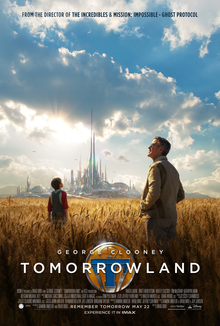
Movie Review: Tomorrowland


Movie: Tomorrowland
Directed by: Brad Bird
Starring: George Clooney, Hugh Laurie, Britt Robertson

Verdict:
Brad Bird’s aggressively optimistic Sci-fi utopia flick tries hard to dazzle with visions of a possible tomorrow, but while Raffey Cassidy’s performance as Athena simmers alongside the special effects, neither were enough to uplift the film’s horrendous pacing and tragically underwhelming plot to anywhere near its promise.

In depth:
For such an effects-heavy film, Tomorrowland was surprisingly muted in most of its previews, being more focused on building an optimistic vibe and buoyant, hopeful atmosphere, rather than on wowing the audience with special effects.  I was initially pleased with this angle, for despite my love of Blade Runner and the rest of the Cyberpunk canon, years of relentlessly bleak and nihilistic dystopian science fiction had ground me low, and while I couldn't stomach a return to the Space Age euphoria of The Jetsons and its relatives, Tomorrowland's exaltation of scientific possibilities as per the previews showed promise in filling a void left in me since Disney’s 2007 animated feature Meet the Robinsons.  Unfortunately, the previews went well beyond merely “doing justice” to the movie - they were downright disingenuous.  Like the film’s hapless protagonists, I felt duped, deceived by a glossy veneer of thoughtful utopian futurism which turned out to mask a spastic and unwieldy film, with seemingly minimal direction and only a heavy-handed “message,” delivered with all the subtlety of a back alley mugger, to greet me at the end.  

Our mournful tale centers around two decidedly different protagonists, both of whom have had their lives altered by contact with the eponymous location. We’re introduced to Frank Walker (Clooney), a bitter and cynical man who is apparently addressing an undisclosed audience about “how we got to here.”  The film throws us back to the 1964 World’s Fair, where an eleven-year-old Walker is gearing up to present his homemade “jetpack” to a very bored Hugh Laurie.  I’ll admit that this is the first - and sadly, only - hope spot in the entire film; the scenery was bright and colorful, and the quasi-philosophical exchange between the boy-genius and Laurie’s character Nix, though hurried and shallow compared to presentations in other movies, did strike at the story’s main nerve: that the invention of any dream, any idea - however fuzzy or incomplete - may spark the seeds of tomorrow’s innovations, if only by willing the heart to consider possibilities.  However, the best part of the beginning was undoubtedly the introduction of Raffey Cassidy as Athena, a young girl with a secret who takes a liking to young Frank and gives him the pin that functions as a pass to Tomorrowland - the hyper-futuristic, creative utopia where all the world’s best minds gather to make the impossible happen.  Yes, it’s true that “English little girl” is usually more than enough characterization to stand out in an American production, but in this case she actually has some meat to her.  Throughout the beginning and going the full nine yards, Cassidy was one snarky, sardonic, butt-kicking, heart string-pulling fountain after another, and the fact that she’s barely past the puberty gateway only makes her ability to meet most of the expectations placed on her all the more impressive.  Her charm and sincerity are all natural, and I wonder what her future has in store for her.

But still, it’s got to be pointed out that Cassidy’s acting chops, even allowing for her age, are only somewhat above adequate, and really only stand out because most of her castmates are sort of a let down.  While I usually enjoy Clooney in most of the films he’s in, this time he came up rather short, playing to stock the most conventional kind of curmudgeon-scorned you could possibly imagine.  However, the exemplary irritation in the acting department  resides squarely with Britt Robertson and her character Casey, the shrill and annoying magnet for most of my frustrations with Tomorrowland.  Playing opposite Clooney as the young, bright, and optimistic science enthusiast, Robertson promised to drive the film’s direction, perhaps bringing Clooney out of the dark and setting a good pace for the rest of the movie.  Unfortunately, she turned out to be a dud, a quintessential example of character shilling who, while smart, never did much more than shout and have her common sense observations called out as “brilliant.”  As with Clooney, her scenes and motivation all amounted to a big “ho-hum,” though I suspect that I probably wouldn’t have noticed as much were I fifteen years younger.  

Worse yet, her appearance coincided with where the plot takes a real nosedive...and pretty much stays at low altitude for over 90 percent of the remainder of the movie.  Story rot doesn’t even begin to cover it; everything spanning from the time she discovered the Tomorrowland pin, until she actually arrives there, was the most bloated, meandering and drawn out stretch of cinema I’ve seen in the past year.  This was supposed to be the point where the plot hits its “meat” - when we learn that not all is sunshine and sprinkles in Tomorrowland, and a contingent of creepy robots are sent to silence Casey from discovering the truth.   Unfortunately, we’re treated to a couple of robot fights, a few extended chases, and a lot of fluff and filler.  It had its moments, I admit - for example, seeing Frank Walker’s near Batman-levels of prepared ingenuity when the bad guys follow Casey to his home was good fun, and one of the best scenes in the movie.  But by and large this hour-long stretch, in an already overly-long 130-minute movie, limped on with little direction, dragging the viewer along while giving no incentive to command our attention other than a sub-adequate jigsaw plot.  Of course, piecing together the story’s “puzzle” might have been fun were there anything at the end of the road worth discovering, but alas, no; they don't even arrive in Tomorrowland until the last 30 or so minutes of the movie, after which everything resolves on the words of the villain’s rather illogical 2-minute diatribe, and not even the surprising maturity by which the movie’s message is presented could offset its heavy-handed delivery, or Tomorrowland's many failings in general.

So was there anything good in this movie?  Well, aside from Cassidy and her antics, the special effects were great, as to be expected.  They were dazzling on their own, but what really stood out was how they dovetailed into the movie’s wider theme of optimism and possibility; the effects, along with the various props accompanying them, had a very “classic” feel, almost as if they were cooked up in the mind of an imaginative ten-year-old - which, when you think about it, may have been the point.  Likewise, they weren’t splattered everywhere, giving the viewer new distractions every 3 seconds, but were used economically, mainly to punctuate how this or that event was in some way “amazing” - and to be honest, it usually worked.  Too bad that even this concession merely damns by faint praise, since the concentrated usage of special effects only highlighted the absolute barrenness of the rest of the film; the draw of flickering lights or a CGI explosion every minute has been the saving throw of many a sub-par movie, as they at least keep the adrenaline amped and the mind numb. But with no such salvation in Tomorrowland, the long desert between the first and last 20 minutes of the movie where nothing of real substance happened felt that much longer.

It’s easy to sneer at my harsh critique - to call me a tin bully, to chide me for cutting down a movie obviously meant to appeal to children.  But that all misses the point; there are many, many, many movies, for children and for adults, that push the same optimistic message of “dream big” with a grace, subtlety, or charm Tomorrowland couldn’t hope to achieve.  While it definitely contained within it the seeds of a solid, mature reconstruction of the future utopianism it tried to embody, we will have to wait another day for a film that can bring those seeds to bloom.

Grade: D